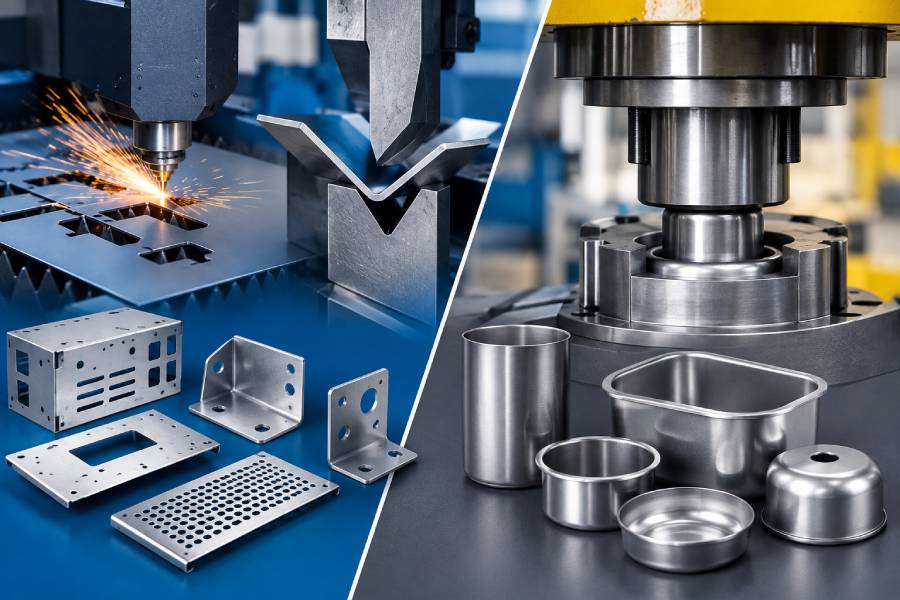
Sheet metal components are essential to countless industrial products, from
machinery enclosures and brackets to automotive assemblies, electrical equipment,
housings, covers, and customized engineering parts. However, not every sheet metal
component should be manufactured using the same process. Two important manufacturing
approaches are conventional sheet metal fabrication and deep drawing.
Understanding their differences can help OEMs select an appropriate manufacturing
process based on component geometry, production quantity, material, strength,
dimensional requirements, and final application.
What Is Sheet Metal Fabrication?
Sheet metal fabrication transforms flat metal sheets into functional components
through processes such as cutting, bending, forming, punching, welding, and
finishing.
It is highly versatile because manufacturers can produce everything from simple
brackets to complex fabricated assemblies. CNC laser cutting and other modern
fabrication technologies also allow manufacturers to achieve repeatable profiles and
efficiently produce customized components.
Sheet metal fabrication is commonly considered when a component contains bends,
cut-outs, mounting holes, slots, flanges, welded sections, or multiple fabricated
elements.
What Is Deep Drawing?
Deep drawing is a metal-forming process used to transform sheet metal blanks into
hollow or three-dimensional shapes using dies and controlled forming pressure.
Instead of fabricating a component by joining several pieces, deep drawing can
produce certain shapes as an integrated part. Depending on component geometry,
multiple drawing stages may be necessary to achieve the required depth and final
profile.
Deep drawn components can be suitable for industrial housings, containers, covers,
cups, shells, automotive components, electrical parts, and numerous customized
engineering applications.
Sheet Metal Fabrication vs. Deep Drawing
The right manufacturing method depends heavily on the component.
Conventional sheet metal fabrication provides flexibility for components involving
cutting, bending, welding, and assembly. It can also be practical for customized
designs and varied production requirements.
Deep drawing becomes particularly valuable when the design requires a seamless or
hollow formed geometry and when repeatability across larger production quantities is
important.
Manufacturers should evaluate component dimensions, drawing depth, wall thickness,
material behaviour, tolerances, tooling investment, and expected production volumes
before selecting a process.
Importance of Material Selection
Material selection directly influences manufacturability and final component
performance. Depending on the application, sheet metal parts may be manufactured
using mild steel, stainless steel, aluminium, or other suitable metals.
For deep drawing applications, material formability is particularly important
because the sheet must withstand significant deformation without unacceptable
cracking, wrinkling, or dimensional variation.
Quality Control for Custom Metal Components
Quality should be controlled from development through final dispatch. Important
considerations can include dimensional inspection, material verification, tooling
accuracy, forming consistency, weld quality, surface condition, and finishing.
Where required, fabricated components may also receive powder coating, polishing,
plating, or other surface treatments.
Custom Manufacturing for International OEMs
Shiv Sai Export & Import supports sheet metal
cutting and bending, custom deep
draw components, pressing parts and associated manufacturing
requirements through its Indian manufacturing network. The company positions its
model around outsourced manufacturing, quality checks, transparency, and export
coordination.
For overseas buyers, this approach can simplify the process of developing custom
parts in India while maintaining a single point of coordination from component
development through shipment.
Selecting the Right Manufacturing Process
There is no universal winner between sheet metal fabrication and deep drawing. The
correct process is the one that best matches the product's geometry, material,
tolerance, volume, performance requirements, and commercial objectives.
Working with an experienced Sheet Metal Parts Manufacturer and Deep Draw
Parts Manufacturer helps buyers evaluate these factors before committing to
production tooling. Proper process selection at the development stage can reduce
unnecessary manufacturing complexity and create a more efficient route from
engineering design to finished component.